Vivo's X Fold6 makes a strong case for tall foldables, with an import catch
Vivo's X Fold6 combines a 7,000mAh battery, a 200MP main camera and unusually capable multitasking, but today's China-market import lacks eSIM and 6GHz Wi-Fi.
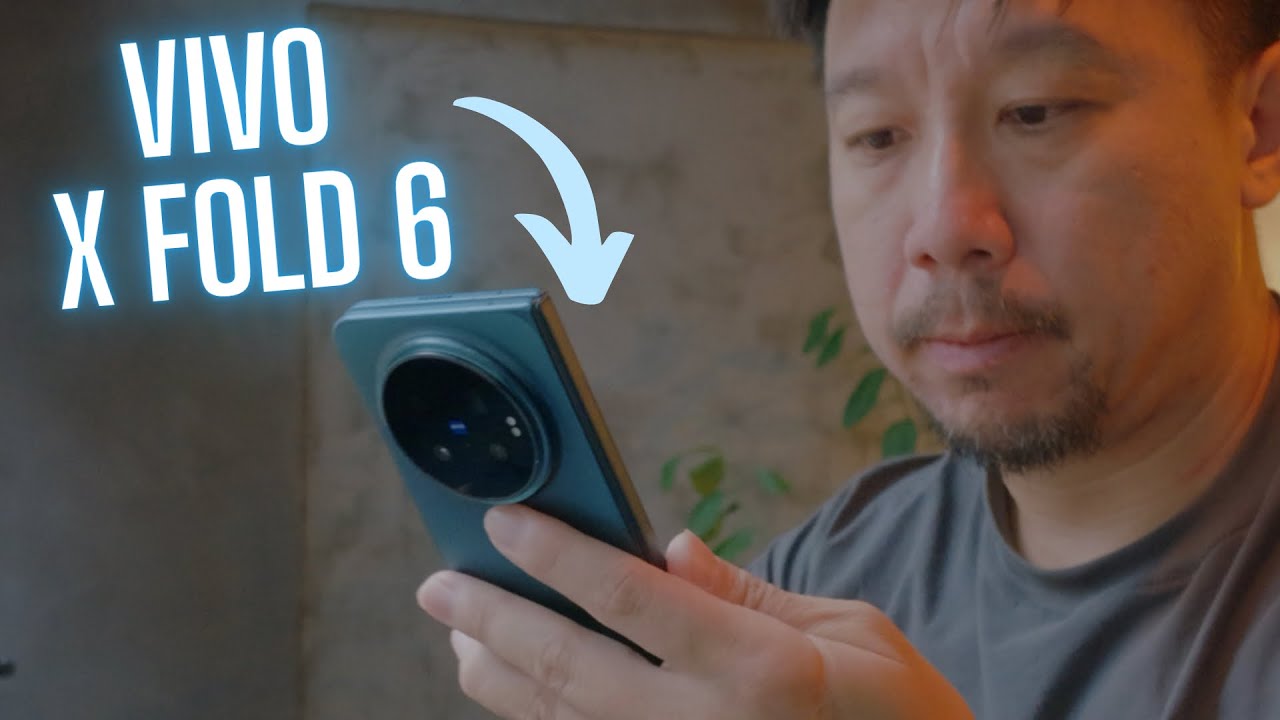
Ben Sin opens his Vivo X Fold6 review by mourning it. Not the phone — the shape. Sin expects Apple's rumoured first foldable to use a wide, passport-style body, and Samsung, Xiaomi, Oppo and Honor to chase the same proportions, leaving Vivo's tall, narrow slab as one of the last of its kind. “When it's folded, you have a device that's actually shaped like a normal phone, and it's easy to use with one hand,” he says. He bought his unit himself, from a Hong Kong importer, because that is currently the only way most people can get one.
That is the whole story of this phone. The X Fold6 pairs unusually ambitious foldable hardware with a basic availability problem: outside China, buyers have to import it and accept the compromises.
The battery is not a rounding error
Vivo put a 7,000mAh cell inside a phone that folds. Tech Spurt's Chris Barraclough called it bigger than any global foldable and set it against the 4,400mAh in Samsung's Galaxy Z Fold 7 — a gap of more than half again. Charging stays at 80W wired, 40W wireless.
The cost is measurable and small. Sin weighed his review unit at a Hong Kong wet market: 235 grams, against roughly 227g for last year's X Fold 5, and 9.9mm folded against 9.4mm. He only notices the difference holding both at once. Anakin, a creator a month into ownership, was blunter about the heft — coming off an Honor Magic V6 he felt it immediately, then stopped noticing. He reports a full day as a heavy user, reckons lighter users would clear two, and says battery health still read 100 percent after a month.
A MediaTek foldable, finally on current silicon
This is the first Vivo foldable built on a MediaTek chip, a Dimensity 9500 variant. Sin frames that as a two-generation jump, because Vivo had spent recent years putting year-old Qualcomm parts in its folding phones — the X Fold 5 shipped with a Snapdragon 8 Gen 3. He concedes the Dimensity benchmarks below Qualcomm's current 8 Elite Gen 5, then says it does not matter for games or video editing.
Anakin found the one place it does matter. Console emulation — Switch, PlayStation, Windows — is where he hits frame problems, and he would have taken a Snapdragon for that alone. Everything from the Play Store, he says, runs at 60 or 120fps without complaint.
The camera is excellent until you pinch
The main sensor moves to a 200MP Samsung HPB at 1/1.4in — the same part Vivo used for the X300 Pro's zoom lens — replacing a 50MP unit. The periscope stays a 3x, 70mm Sony LYT602 on a 1/2in sensor; the ultrawide remains 50MP. Sin, who shoots almost everything at a 2x in-sensor crop, says that is where the upgrade shows.
Rome, of Rome Reviews Tech, ran into the other side of it after a week. A photograph of a deer in scrub looked fine until he zoomed in: “That is water color. That is not the deer.” Then he noticed the leaves had gone the same way. He is careful to say Vivo is not alone in this, and equally careful to praise a dark-room shot of his son where detail held up. But past roughly 3x, in his experience, the processing stops photographing and starts painting.
What the Chinese unit quietly leaves out
Notebookcheck's Daniel Schmidt catalogued the gaps in the China-market model his team tested. It supports Wi-Fi 7 but not the 6GHz band, which he calls unusual for a current high-end phone. There is no eSIM. Google and Gemini are not deeply integrated into the software. Chinese configurations run from 12GB/256GB to 16GB/1TB, and which reach other markets is unknown. His advice to importers is to check feature support first, because the differences from the eventual global version may be significant.
Sin works around those gaps. Google Play installs from Vivo's own app store in about ten minutes; delayed notifications improve, though not fully, once you allow background processing per app in the battery settings. Anyone bothered by that, he says, should wait for the global release.
Crease, and other small irritations
Three reviewers, three readings of the same fold. Sin says it is better than the X Fold 5's and still short of the Oppo Find N6, where a finger dragged across the panel feels nothing at all; here he feels a subtle groove. Rome, who has been using a Find N6 daily, calls the X Fold6 crease considerably more noticeable — visible after a wipe-down, findable by touch if you look for it. Anakin, comparing against an Honor Magic V6 after a month, lands on neither best nor worst, and definitely not Find N6 territory.
The rest of Anakin's month produced a list no spec sheet carries. Both speakers fire from the same edge, so video without headphones has no stereo image. The fingerprint reader is noticeably slower than his other phones. Auto-rotate triggers on the slightest tilt. The selfie camera locks to 1080p30, then imposes that on the rear cameras when you flip back.
What both he and Rome keep returning to is multitasking. Half-folding the phone and letting it spring back opens a four-app picker; the windows resize freely, pinch out into a full-screen focus mode, and collapse into Origin Workbench with a corner swipe. Sin notes plainly that Vivo copied Oppo's system, and that he is glad it did.
The buyer case starts with geography
Vivo has confirmed the X Fold6 will sell outside China following its 26 June debut there, without saying when or where. Until that happens, the strongest argument for a tall foldable is a phone most buyers can only reach through a grey importer, missing 6GHz Wi-Fi and eSIM, running software that needs an afternoon of setup before Google works properly. Sin's own advice is worth repeating: X Fold 5 owners have little reason to move, while anyone on an older Xiaomi or a Galaxy Z Fold 6 will feel the battery and camera immediately.