Honor built a gimbal into a phone, then aimed its sensor sideways
Honor's Robot Phone nearly matches a pocket gimbal at tracking and stabilization. Its oddest compromise appears when creators turn to vertical video.
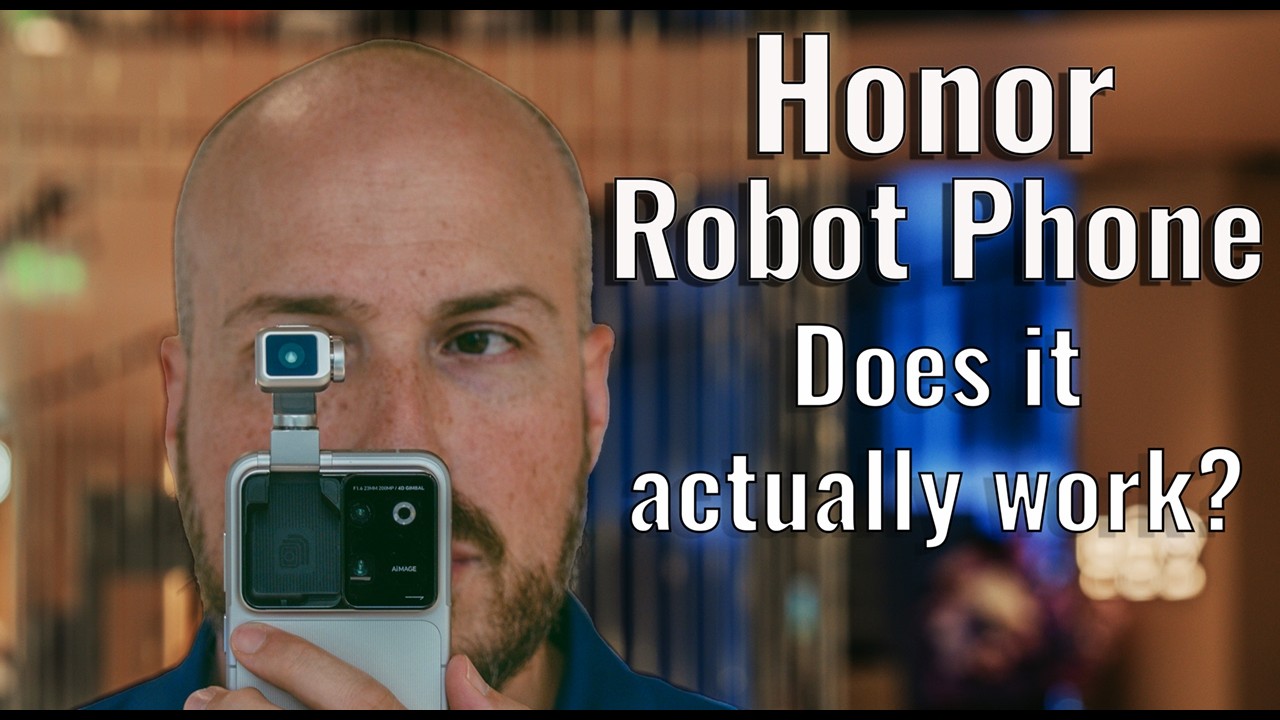
The Honor Robot Phone can sit on a table, recognise its subject and swing a 200-megapixel camera around to keep that person in shot. It can smooth walking footage with real motors rather than a software crop. It can even deploy the camera arm after a hand gesture. This is the rare phone whose party trick survived contact with working hardware.
Then you ask it to film the format that dominates TikTok, Reels and Shorts. The phone stays upright, but its gimbal sensor stays landscape. Vertical video is carved out of that horizontal frame at roughly 2.8K rather than captured in native 4K. Honor built perhaps the most creator-focused phone of 2026 and gave it a wonderfully physical version of an old camera problem: orientation matters.
The phone really does replace some gimbal work
Honor's mechanism puts a 200MP, 1/1.28-inch main sensor with an f/1.6 lens on a motorised three-axis arm. Slide its transparent cover aside and an onscreen control unfolds the camera. The software offers manual pan and tilt, subject tracking, FPV modes and an extra Super Steady layer. Fold it away and the same camera shoots through the cover like an ordinary rear camera.
Tom's Guide's Sanuj Bhatia compared the production phone first with an iPhone 17 Pro Max, then with an Insta360 Luna Ultra pocket gimbal. Walking footage from the Honor showed fewer small movements than the iPhone, while its tracking followed a person around a busy waterfront about as reliably as the dedicated camera during normal movement. The Luna pulled ahead when the subject moved quickly towards the edge of frame, and remained quicker to launch and easier to hold through a long shoot.
That is a much more useful result than saying the gimbal merely works. Honor has put the tracking experience of a pocket camera into a 9.6mm phone without abandoning the rest of a flagship. The Robot Phone also has a fixed 200MP 2.7x periscope camera, a 50MP ultrawide, Snapdragon 8 Elite Gen 5 and a 7,060mAh silicon-carbon battery. Its body weighs 248g, heavy for a 6.31-inch handset but far easier to pocket than a phone plus another camera.
Vertical capture exposes the geometry
The unusual handling takes a moment to understand. PetaPixel's Ted Kritsonis found that the phone must remain physically upright while the deployed gimbal records either landscape or portrait, selected in software. Turning the handset sideways does not make the camera arm rotate with it. Your hands still set the broad framing; the little motors correct jitters and keep the chosen subject centred.
That design is sensible for balance, but it explains the vertical-video penalty Bhatia found. The sensor's native landscape orientation does not change, so portrait recording crops the sides and produces about 2.8K output. His iPhone comparison could record vertical video at up to 4K 120fps, and the iPhone also produced cleaner low-light footage. Honor wins movement and autonomous framing, not every measure of image quality.
The Robot Phone's ARRI collaboration adds LogC3 recording, cinematic looks and manual controls, though the workflow has another early wrinkle. Kritsonis found the default APV lossless files would not preview on Apple devices and needed conversion through DaVinci Resolve; HEVC was available as the more compatible option. ARRI tools and a mechanical gimbal sound like a miniature film rig. A creator still has to check whether its files and orientation fit the job.
The glass door is also the repair question
This camera cannot be treated like a sealed slab. The phone is rated IP54, enough for splashes but not submersion, and the sliding cover is chiefly there to keep dust away from tiny moving parts. Kritsonis thought that cover felt vulnerable, although Honor hardware engineering president Yang Liu told him it was designed for straightforward replacement. Honor is also considering swappable covers that could work as neutral-density filters.
Heat appeared during extended gimbal use in his shared hands-on session, and no reviewer cited here had a retail unit long enough to measure battery drain, motor longevity or drop survival. Those gaps help explain why sales and repairs remain confined to China. Honor lists the 12GB/512GB model at RMB 9,999 and the 16GB/1TB version at RMB 12,999, with no announced global release.
A brilliant first draft, aimed at landscape
The Luna Ultra remains the better dedicated tool in Tom's Guide's comparison. It starts faster, tracks hard movement a little better, is more comfortable over long sessions and has dedicated zoom hardware. The Honor counters with a telephoto camera, a large screen, instant editing and sharing, and one fewer object to remember.
That trade makes the Robot Phone compelling for solo presenters, travellers and anyone who regularly leaves a phone on a stand to film themselves. It is less persuasive for creators whose finished frame is always vertical and whose clients expect native 4K. The first version proves the folding arm is more than theatre. A second version needs to let its remarkable camera turn fully towards the work people actually publish.