Hisense built an E Ink phone with a colour screen you can take off
The A10 Ultra pairs a 6.13-inch E Ink panel with a magnetic 4.96-inch LCD on the back. Early hands-on reports suggest the unusual compromise can work.
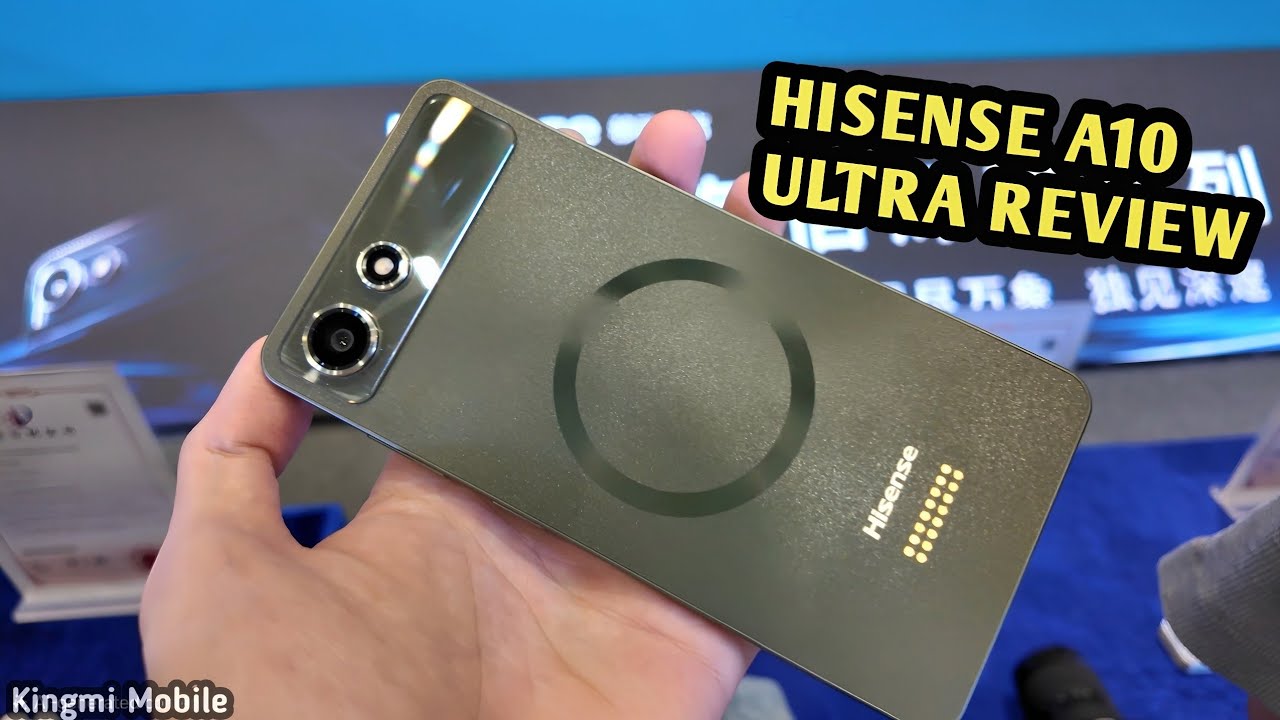
Every year somebody builds an E Ink phone, and every year the same thing kills it: the screen is wonderful for words and useless for everything else. Hisense's answer, now on sale in China, is to stop arguing with physics. The A10 keeps a monochrome E Ink panel on the front and lets you magnetically slap a small colour LCD onto the back when you need one. When you don't, you leave it in a drawer.
It is a genuinely odd solution, and after watching several people handle it, it might also be the right one.
The front half
The main display is a 6.13-inch E Ink Carta 1300 panel at 1,648 x 824 and 300 pixels per inch, paired with a T2000 timing controller. It supports 256 grey levels and a front light with 36 steps of warm-to-cool adjustment. Kingmi Mobile, who handled the Ultra at Hisense's launch event, described the panel as very white and clean with almost no ghosting while reading — the specific failure mode that makes most E Ink phones exhausting.
Underneath is a Qualcomm QCM6690, a 4nm octa-core Dragonwing part with 5G, running Android 16. That last detail matters more than the chip name. Kingmi's reviewer, who spent several days with the A10 Pro, made the point that E Ink phones usually fail on third-party app compatibility — glitched interfaces, dead taps, sluggish scrolling, stuttering video — and that a current Android base helps address it. He reported no crashes across news apps, note-taking and video.
Battery is 4,000 mAh with 18W wired and 15W wireless charging. The Ultra adds magnetic wireless charging. In the most useful figure anyone has produced so far, Kingmi's reviewer said he read on the A10 Pro for more than 30 hours straight before recording and the battery had dropped 13 percent, with the phone still cool to the touch. E Ink only draws power when it refreshes, so that number is plausible rather than remarkable — but it is the reason anyone tolerates a monochrome phone in the first place.
The back half
The detachable panel is a 4.96-inch 60Hz LCD held on by a magnetic ring and connected through pogo pins. The pins are the interesting part: a physical connection means the latency is nothing like wireless screen mirroring, and Kingmi reported gaming on the rear screen with responsive controls and no visible lag. Hisense has said it intends to open the pogo pin interface up so third parties can build other attachments onto it, which is either the start of a small accessory ecosystem or a sentence in a press release.
A dedicated ink button on the left flank switches between the two screens with a short press, and can be remapped for single press, double press and long press — screen refresh, cloud note capture, whatever you use most. There is also NFC, an IR blaster, a side fingerprint reader, a 48MP main camera and an 8MP selfie camera. Because the rear camera sits above the LCD, you can frame shots on the colour screen instead of the E Ink one, which turns the awkward camera preview problem into a party trick.
The cost is bulk. Kingmi reckoned the phone plus rear screen plus the matching case lands in roughly the same weight class as an iPhone 17 Pro Max with a case on, perhaps a touch heavier. The phones themselves are listed at 190 grams.
Pro, Ultra, and what you actually pay
Hisense sells two versions. The Ultra includes the colour screen and adds magnetic wireless charging; the Pro has the contacts but leaves the screen as an optional purchase. The A10 Pro runs 2,799 yuan for 8GB/128GB, 2,999 yuan for 8GB/256GB and 3,499 yuan for 12GB/512GB — roughly $416 to $521. The A10 Ultra, which includes the panel, runs 3,198 / 3,398 / 3,898 yuan, or about $476 to $580. Buy the Pro and change your mind later, and you can add the screen separately.
That is notably cheaper than the pre-launch estimates. Engadget, covering the phone in July before specs firmed up, expected around $590 for the E Ink-only model and described it as running a Snapdragon 8 Gen 3 — a flagship chip that did not materialise. What shipped is a mid-range part, and the pricing followed it down.
Importing changes the calculation
These are Chinese-market phones. There is no Google Play Store on board; Good e-Reader notes you sideload APKs for Kindle, Libby and the rest. A US launch looks unlikely, so import channels are the realistic route, with all the warranty and band-support caveats that implies.
Hisense also is not alone here — Bigme showed the HiBreak Dual 3, its own E Ink phone with a magnetic LCD, in late August. Two companies converging on the same detachable-screen idea in the same month suggests the category has found its shape. The A10's own pitch, as one reviewer put it, is that dual screens solve the scene-switching problem, the ink button solves the interaction problem, and a decent camera and NFC solve the "but it can't be my only phone" problem. Whether that is worth carrying an extra slab of LCD around is a question only a certain kind of reader will answer yes to. Hisense appears to have found them.