Samsung's short Galaxy Z Fold 8 is the foldable reviewers keep carrying
The Fold 8 is not the successor to last year's Fold 7. After weeks of reviews, the new passport shape is the one people pocket, even with no telephoto and a $1,900 price.
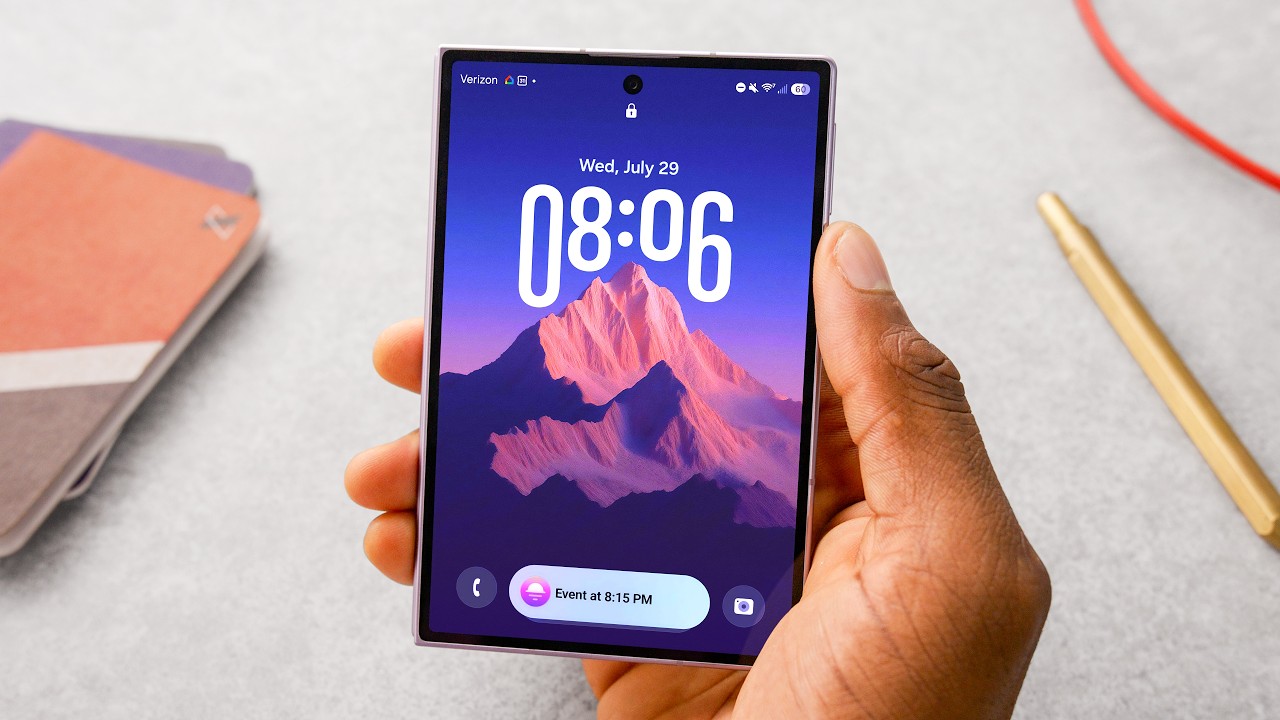
Samsung spent July explaining a naming trick that still trips people up. The phone that replaces last year's Galaxy Z Fold 7 is the Z Fold 8 Ultra: tall cover screen, 200-megapixel main camera, 3x telephoto, Flex Mode. The phone reviewers have been carrying since late July is the other one. The Galaxy Z Fold 8 is a new, shorter shape that starts at $1,899 and shares almost none of last year's silhouette.
GSMArena admitted the naming “could have been better selected.” CNET's Abrar Al-Heeti said it plainly in her verdict: the Ultra is the true follow-up to the Fold 7. The Fold 8 is the one that turned heads at London's Borough Market, where a stall worker, watching some thirty reviewers raise the same lavender handset, asked, “Why do you all have the same phone? I feel like I’m in the Matrix.”
The short phone that replaced the tall slab
Samsung built the Fold 8 around how people actually watch things, not how they imagine they work. Drew Blackard, the company's senior vice president of mobile product management, told WIRED that consumers now watch 80 percent of their video on mobile devices, “not in front of a TV screen or tablet,” and that the shape of that video has split: landscape for Netflix, vertical for social apps. Closed, the Fold 8 has a 5.5-inch 10:16 cover screen. Open, a 7.6-inch 4:3 inner panel. Rotate it and the same sheet of OLED becomes a tall 3:4 canvas for reading.
The hardware that makes the trick pleasant is unglamorous. It weighs 201 grams, which Samsung calls its lightest book-style Z Fold. Unfolded it is 4.5mm thick. Marques Brownlee, after a week of daily use for his review, found almost the entire cover display reachable one-handed and compared the open-and-close action to a notebook. Shane Craig, coming off last year's Fold 7, was blunter: after a week on the short phone, a tall slab looks absurd. “I don't know why we have accepted phones being this tall for so long,” he said.
Mark Spoonauer of Tom's Guide said Samsung finally fixed two of his biggest foldable irritations. Flex Titanium, a titanium-alloy film and plate under the OLED, shrinks the crease until it is hard to see in video. An anti-reflective coating on the inner panel makes the drop in outdoor glare “night and day” versus the Fold 7. GSMArena's lab measured the inner screen at more than 3,000 nits peak, matching Samsung's claim.
What Samsung took out to make it fit
The Fold 8 is thinner and lighter than a camera-heavy Ultra because Samsung left hardware on the table. The rear cameras are a pair of 50-megapixel sensors, wide and ultrawide. There is no telephoto. Brownlee's verdict once he had stopped admiring the shape was that the photos are merely fine, which stings more on a $1,900 phone. Spoonauer was less polite. Charging $1,900 in 2026 “and dropping the telephoto zoom lens entirely is frustrating.” Digital 10x, he said, looks blurry next to the Ultra or Motorola's Razr Fold.
Craig, who stacked 3x crops against Samsung's own small 10-megapixel telephoto on the Fold 7 and Fold 8 Ultra, was more forgiving. At 3x and even 5x, the gap is smaller than the spec sheet implies. Past 5x, neither looks great. Birders should buy something else. Everyone else, he argued, will live.
The redesigned hinge also killed Flex Mode on the standard model. The Ultra still props open like a mini laptop. The Fold 8 snaps shut. You can still tent it on the cover screen — Al-Heeti watched Downton Abbey that way — but there is no software split of video on top and controls below. Dust protection is still IP48: 1.5 metres of fresh water for 30 minutes, and no rating against fine grit. Google's Pixel foldables advertise IP68.
Open the Fold 8 in landscape and both speakers sit on the left. Brownlee and Craig both heard the stereo collapse to one side of a film. GSMArena's loudness test rated the phone Average. The speakers sound decent; they just fire from the wrong half of the screen.
Two hundred dollars is not a discount
The Ultra starts at $2,099. The Fold 8 starts at $1,899 for 12GB of RAM and 256GB. Step the Fold 8 up to 512GB and it costs $2,099, the same as the Ultra's base SKU. Spoonauer's advice was accordingly narrow: buy the Fold 8 only if you specifically want the short, passport-shaped phone. Do not buy it to save money.
On paper the Ultra is the better machine: 8-inch inner display, 200-megapixel main camera, 10-megapixel 3x telephoto, 5,000mAh battery, Flex Mode. The Fold 8 answers with a 4,800mAh silicon-carbon pack, the Snapdragon 8 Elite Gen 5 for Galaxy, and 45W wired charging. GSMArena reached 65 percent in 30 minutes against Samsung's 63 percent claim, and just under 14 hours of active-use score. Spoonauer's Tom's Guide test lasted nearly an hour and a half longer than the Fold 7. It is enough for a day. Honor and Motorola still ship bigger packs and faster chargers.
Brownlee, after the novelty wore off, still liked the phone. “The honeymoon period's over. And I still really like it.” He also said that on paper, $1,900 is not that convincing: smaller screens, smaller battery, fewer cameras, the same chip as other flagships. Craig treated that gap as the whole point. The Fold 8 will not win a spec war. The aspect ratios — 16:10, 4:3, 3:4 — are the reason to buy it.
Apple's rumoured foldable is expected in a similar squat shape within months, which will end the Fold 8's run as a niche of one in Western shops. Buy the Ultra and you are buying last year's Fold, improved and fully specified. Buy the Fold 8 and you are buying a shape — a short phone that opens into the rectangle people already know from paperbacks and small tablets. Samsung picked a genuinely confusing name for the more interesting product.