Oppo built a superb 300mm phone lens, then trapped it in the wrong camera mode
Independent tests say Oppo's £499 Hasselblad teleconverter has genuine optical bite. Its JPEG-only official mode, limited controls and 400g bulk keep it from behaving like pro gear.
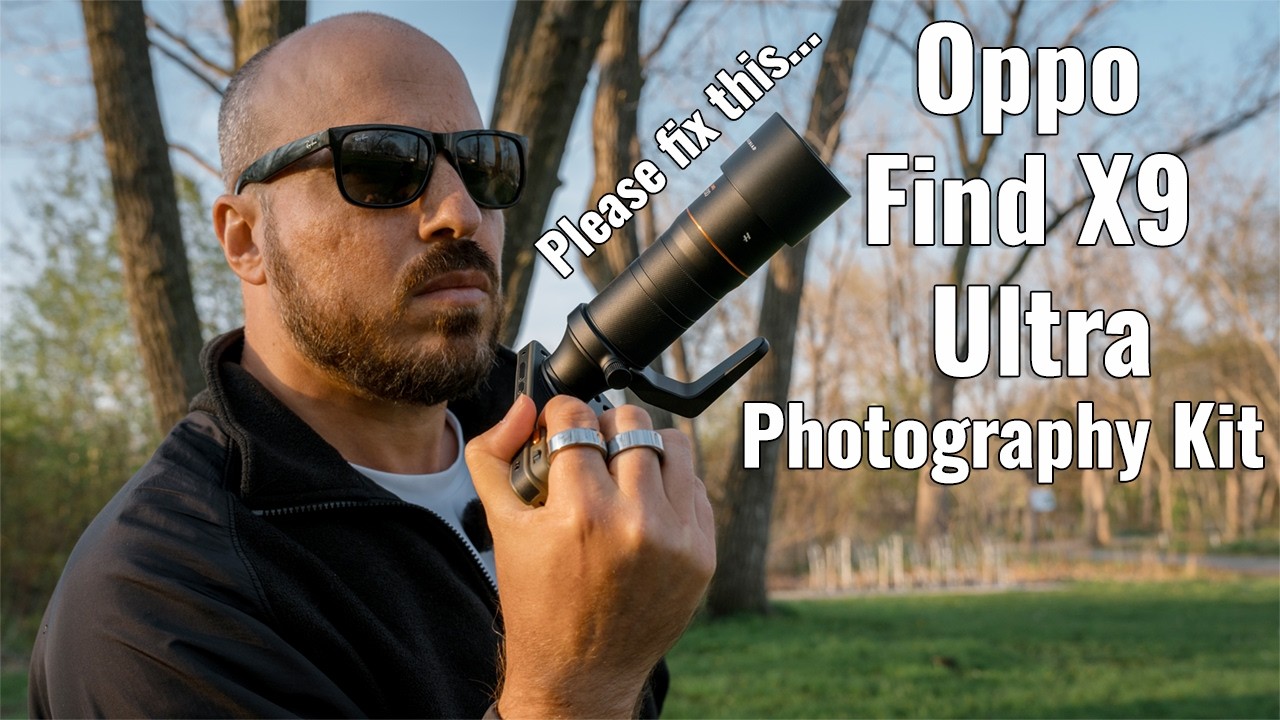
A 400g lens hanging from a phone case sounds like cosplay for photographers. Oppo's Hasselblad 300mm Explorer Teleconverter is annoyingly better than that joke. It mounts in front of the Find X9 Ultra's 3x camera, turns its large 200MP sensor into a 300mm-equivalent system and, in a recent controlled test, produced centre sharpness competitive with full-size camera lenses.
Then the camera app gets involved. Oppo's dedicated Teleconverter mode records JPEGs, offers only a narrow selection of controls and does not inherit the useful action tools from the normal camera. The company has built the rare phone accessory whose optics deserve more freedom than its software permits.
The optical result is not a marketing prop
The Earth Explorer Kit costs £499 in the UK and is sold only in selected European and Asian markets. The teleconverter has a metal barrel, removable tripod collar, hood and a bayonet mount built around a dedicated case. With the collar fitted, Digital Camera World measured the assembly at just over 400g. The case adds a two-stage shutter button and zoom rocker over Bluetooth, although its separate battery cannot charge the phone.
The important choice is behind the mount. Rather than enlarge the Find X9 Ultra's smaller built-in 10x camera, Oppo places the converter over its 3x module, whose 200MP sensor is nearly as large as the main camera's. The result is a native 300mm-equivalent view, or 13x in phone-camera language. The app also offers 30x and 60x, but those steps are digital and the latter uses AI processing.
Ben Andrews at Digital Camera World forced the system into RAW for a controlled comparison, despite the official mode not supporting it. The image appeared upside down, a consequence of selecting the 3x module manually through the converter, but it could be rotated after capture. His measurements put centre sharpness above Nikon's discontinued AF-S 300mm f/4E and close to a modern Tamron 70-300mm at its long end. Fringing was effectively absent, though Andrews cautioned that Oppo may bake aberration correction into its RAW files.
That caveat matters. A phone RAW file is not necessarily untouched sensor data, and the comparison does not make a tiny sensor equal to full-frame equipment in low light, autofocus or subject isolation. It does establish something narrower and useful: the external lens itself is not the weak link.
A sports match exposes the missing controls
TechRadar's Tim Coleman took the kit to a Champions League match in place of a camera setup worth about $10,000. The fixed 13x view got noticeably closer than the phone's built-in 230mm-equivalent 10x camera, while using the better 3x sensor underneath. At 30x, computational processing remained usable. At 60x, reach became the achievement rather than image quality.
Fast action under stadium lighting also found the ceiling. Coleman reported processed-looking faces even at 13x and results well short of his mirrorless camera and telephoto zoom. His proposed fixes were tellingly modest: put Action mode into the Teleconverter interface, or bring across parts of Hasselblad Master mode. This is not a demand for new glass. It is a request for Oppo to connect software it already ships.
ByTeddyK reached the same friction in a video devoted to the Earth Explorer Kit. After testing the lens, grip, filter ring and collar, the review centred on what the system would not allow alongside the strong image quality. Joshua Vergara's real-world camera test was warmer about the kit as a travel tool, but treated it as something to decide whether to pack, not an attachment that lives on the phone. Tech Spurt likewise positioned the optics and tele-extender as the main reason to choose the Ultra model, while noting that Oppo's large camera phone is more than a single-purpose device.
Thirteen times zoom also means one camera at a time
The converter physically leaves the other rear lenses uncovered, yet its barrel intrudes into their fields of view. Changing from 300mm to an ultrawide or normal view therefore means detaching it. If a user simply opens the regular 3x camera with the lens mounted, the image is inverted. The intended route is the special mode with three focal-length buttons and JPEG output.
Those details separate a clever optical system from a coherent camera system. The supplied 62mm filter adapter is particularly appealing for video shooters who use neutral-density filters, but the restricted mode works against the manual workflow that would justify carrying filters, a tripod collar and a lens as long as the phone.
Compatibility is narrow too. PetaPixel notes that the X9 Ultra uses a different mount from earlier Oppo phones, so neither this lens nor older converters cross generations. At £499, a one-phone accessory needs either long software support or a credible adapter path to feel like photographic equipment rather than a premium consumable.
The buyer is easy to describe
This kit makes sense for daylight sport, concerts, wildlife and travel details where 300mm changes the picture and a normal phone zoom would manufacture too much of it. Its 13x setting is the reason to buy it. The 30x option is a useful crop, while 60x should be treated as an emergency telescope.
It does not replace a fast mirrorless sports setup, and it is too heavy and specialised for casual street photography. Yet dismissing it as a gimmick now ignores both field results and the RAW workaround. Oppo has solved the hard optical problem. A software update that adds RAW, action capture and proper manual controls would solve the strangely self-imposed one.