Snapdragon 8 Elite Extreme Gen 6 Benchmarks: The 85% Claim Meets the Charts
Reference-phone tests of Qualcomm's 2nm flagship show a big graphics jump, a small multi-core gain, slower heat build-up and a GPU gap to Apple's A20 Pro.
Prepared by theBench·how our desks work
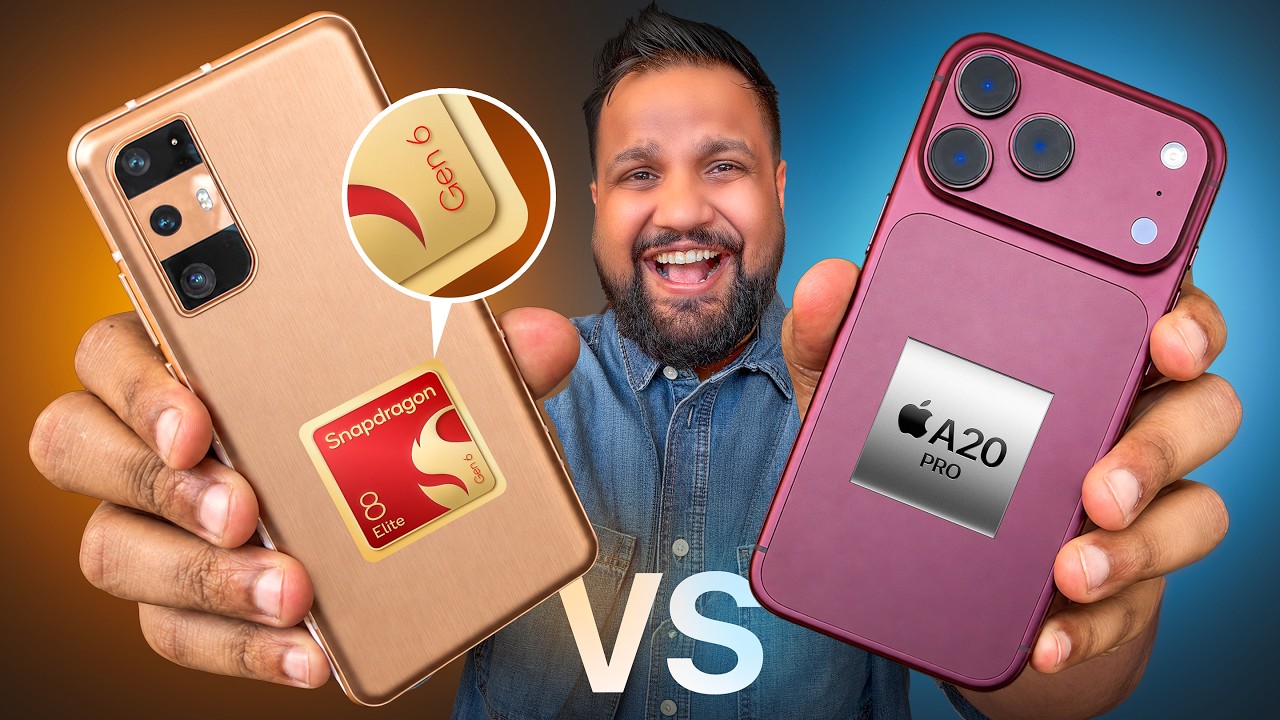
Qualcomm's pitch for the Snapdragon 8 Elite Gen 6 family is that it "delivers 85% better performance while consuming 20% less power than last year's Snapdragon 8 Elite Gen 5," in the wording Android Headlines relayed from the company. The reviewers who have since run the top Extreme variant on Qualcomm's reference phone found a smaller CPU gain, one large graphics jump, slower heat build-up and a clear deficit to Apple's A20 Pro. None of them had a retail phone, so every figure below is provisional.
What the reference phone scored
Android Headlines tested a reference design with a 6.73-inch display, 24GB of RAM and 1TB of UFS 5.0 storage. Against a Gen 5 reference unit it recorded these raw numbers:
- AnTuTu: 5,522,833 versus 4,084,711, a gain of about 35% by simple division.
- Geekbench 6 single-core: 4,329 versus 3,739, about 16%.
- Geekbench 6 multi-core: 12,748 versus 12,101, about 5%.
- Geekbench 6 GPU: 29,021 versus 23,721, about 22%.
Those percentages are this desk's arithmetic. The article's own labels, 65% for AnTuTu and 82% for single-core, do not match its raw figures, so the raw figures are the ones to trust.
GSMGoTech's roundup of results from Qualcomm's reference hardware lands in the same place on the CPU: roughly 12% single-core and 6% multi-core. It adds a 23.6% lift in Speedometer 3.1 and a 3DMark Steel Nomad Unlimited jump from 23 fps to about 44 fps. Wild Life Unlimited moved the wrong way, down 2.1%.
The 85% figure and the heat
The 85% claim does not show up in the CPU tables. The more useful question is what the extra headroom does under load. Korea's Digital Today ran the chip and found that Geekbench 6.5 single-core (4,308) and AnTuTu both came in slightly below the lower bound of Qualcomm's own expected range, with 3DMark Wild Life Unlimited about 8% under it. Speedometer 3.1 beat the range, at 60.8. The outlet reported the device became uncomfortably hot and said its continuous runs differed from Qualcomm's three-run average.
Qualcomm's response, as Digital Today quoted it: "AI performance varies depending on end-to-end optimisation, software and the types of models being run, so it is not possible to fully verify platform improvements with benchmarks alone."
Heat is where the new packaging shows. The Extreme part uses an offset package-on-package layout that puts the memory beside the silicon instead of on top of it. Wccftech reported that Geekerwan's engineering-prototype test took 915 seconds to reach 105°C with the new chip, against 390 seconds for a Gen 5 with traditional packaging. Wccftech also noted that Geekerwan did not say which tests it ran or what the ambient temperature was. That is a delay in throttling, not an end to it, and it came from a prototype.
Where Apple still leads
Trakin Tech's host compared the chip with an A20 Pro iPhone and a Dimensity 9600 Pro phone. On Geekbench 6, the Snapdragon scored 4,291 single-core and 12,684 multi-core, with the A20 Pro at 4,742 and 12,746. The Dimensity was at 4,204 and 12,206. The host's summary: the 5GHz prime core is a milestone, but the fastest single core is still Apple's.
Graphics split by test. In Steel Nomad Light the Snapdragon averaged 32.56 fps, the Dimensity 31.92 and the A20 Pro 27.8. In the ray-tracing Solar Bay Extreme it fell back to 15.84 fps, behind the Dimensity at 21.4 and the A20 Pro at 20.6. The host said Qualcomm told them ray tracing had improved over last year but was not pushed hardest this time, and that the company's bet is the Adreno Neural Fusion upscaling and frame-generation features.
MakeUseOf's Geekbench 7 comparison shows a bigger gap. The Snapdragon's GPU score was 26,107 against 62,351 for the iPhone 18 Pro, which MakeUseOf described as "more than double." It still led on multi-core, 11,736 to 10,765, and was 75% faster than Google's Tensor G6. The reference phone's 24GB of RAM is far beyond what most shipping handsets will carry, and MakeUseOf flagged that as a reason its results would vary on retail devices.
Who should care
Buyers of the first Gen 6 phones, which the Trakin Tech host said include Xiaomi's 18 Pro and 18 Pro Max and a Motorola Signature 27, should treat these numbers as an upper bound. The evidence so far points to a modest CPU upgrade, a real gain in some graphics workloads and better thermal headroom on paper. The sources agree that sustained performance, battery draw and skin temperature in a finished phone are still unmeasured, and the gap between Qualcomm's figures and the independent ones is a reason to wait for retail reviews before paying a flagship premium for the chip.