Siri AI launches September 14, but its usage limits remain unclear
Siri AI arrives in beta with iOS 27 on September 14. Apple warns of usage limits and future paid access, but has not explained when caps take effect or how much users get.
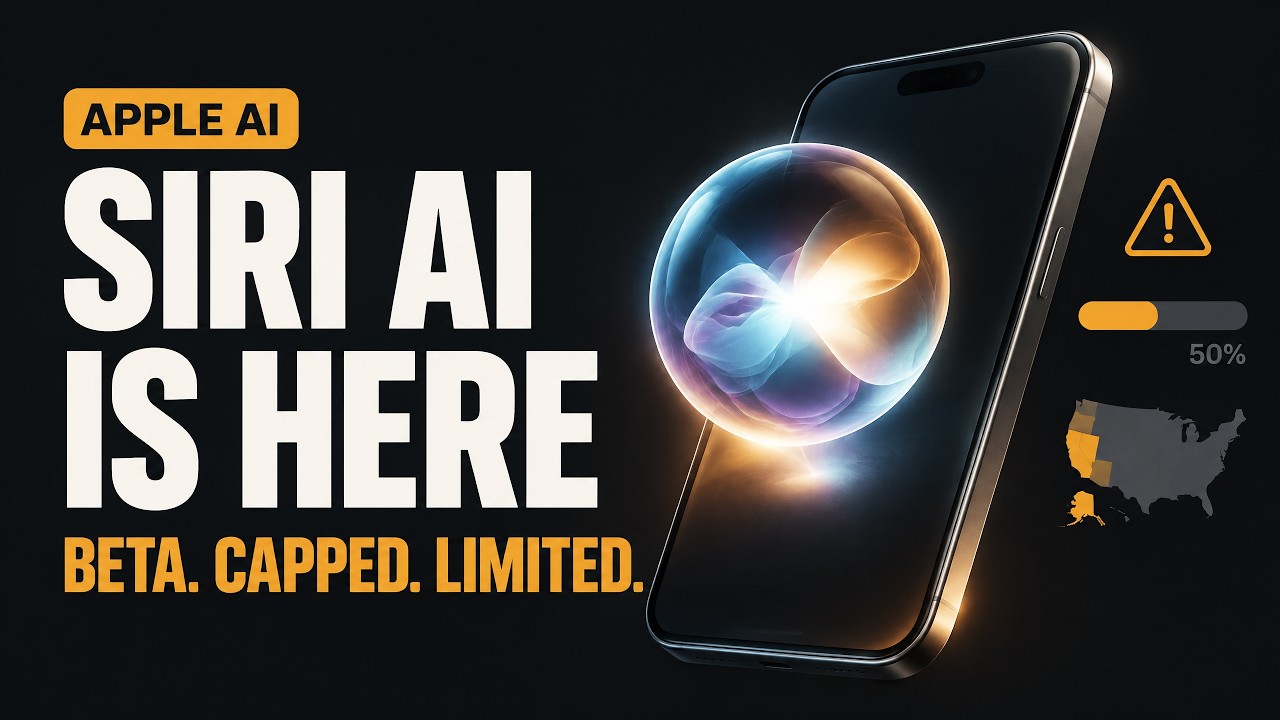
Image: Past The Hype video artwork. Its percentage graphic is illustrative, not a measured Siri allowance.
On September 14, iOS 27 brings Siri AI to supported iPhones. Apple says it can find an email buried in your inbox, act within apps and continue a conversation from iPhone on iPad. The allowance is less clear: Apple's product page warns that usage limits may apply, while its September 9 support note says limits will be implemented in the future. Neither gives buyers a launch-day request count.
The cap has no published start date
Apple's support note lists the cloud features it plans to limit and says access will resume after a timeout when a limit is reached. It says limits can depend on the feature, request complexity, demand and system policies, with increased access available for a fee. The note also refers to the 2027 software releases, despite being dated September 9, 2026. That wording needs clarification before treating it as a precise timetable for this month's rollout.
The policy does not promise a fixed daily number that is the same for everyone. A simple request on a quiet morning may count differently from a complex one during a launch-week rush. Apple has given itself enough room to change the limits as demand changes.
Siri, photo edits and cloud models are on the list
The support note names these server-dependent features:
- Siri AI itself
- The intelligent photo editing tools: Clean Up, Extend and Spatial Reframing
- Image Playground
- The AFM 3 Cloud and AFM 3 Cloud Pro models when called from Shortcuts
- Third-party apps using Apple Foundation Models in Private Cloud Compute
ZDNET's Lance Whitney points out that Apple describes AFM 3 Cloud as the fast “workhorse” model and AFM 3 Cloud Pro as the heavier model for agentic tools and complex reasoning. The developer-app entry matters because a third-party app using Apple's cloud models may draw on the same limited resource.
Apple has published a separate camera allowance. Its support note says that Apple Intelligence in the Home app works with a set number of security cameras based on your iCloud+ plan: one camera on 2TB, two on 6TB and five on 12TB. At WWDC, Apple also said higher iCloud+ tiers would come with expanded access to the limited features. That links iCloud+ to expanded access, but it does not establish the price or Siri allowance for any plan.
The Mac Observer went through Apple's iOS 27 and iPhone 18 Pro pages and found the limit mentioned only in footnotes, without a number, a price or a date. Its unanswered questions include:
- How large the daily allowance is, how it is counted and when it resets
- The price, format and launch date of the paid expanded-access tier
- When Siri AI leaves beta
- Whether iPhone 18 Pro owners get any more than other Apple Intelligence iPhones
The last question will matter to people spending at least $1,199 on a phone that Apple promoted with AI features.
Language, region and hardware narrow the rollout
Some people won't reach the limit because they won't have access to Siri AI in the first place. AppleInsider reports that it launches in English only, with French, Japanese, Korean, Portuguese and Spanish due in October. It won't initially be available in mainland China. In the European Union, Apple is holding it back on iPhone, iPad and Apple Watch but allowing it on Mac and Vision Pro. Users under 13 can't use it. Code found in August also pointed to a possible waitlist tied to server capacity, which Apple hasn't confirmed.
Hardware is another barrier. iOS 27 supports the iPhone 11 and later, but Apple Intelligence features require an iPhone 15 Pro or iPhone 16 or newer.
A beta needs a trial before it becomes a habit
Andrew, who hosts the YouTube channel Past The Hype, argues that the limits change the question buyers should ask. It is no longer just whether Siri can do something, but how often it can, where, and what happens when Apple's servers are busy. He also points out that the most impressive demos, like searching personal data, reading the screen and acting across apps, are probably the most expensive for Apple to run. He sees the older-iPhone split as Apple separating which devices get the software from which get the intelligence, and doesn't call it planned obsolescence. He also makes the counterargument himself: a staged rollout with a beta label is more honest than presenting a complicated agent as finished.
Treat the first few weeks as a trial. Test the tasks you actually need, especially batch photo edits or requests that cross several apps, before relying on them for time-sensitive work. If a timeout appears, note the feature and the message Apple shows. That experience can help you judge a future paid offer, but it cannot establish a universal limit for other users.
Sources: MacRumors · AppleInsider · ZDNET · The Mac Observer · Past The Hype video · Apple Support · Apple iOS