The 25W on your Qi2 charger is a permission, not a power rating
Independent tests show that Qi2.2's 25W ceiling depends on the phone, case, magnetic alignment, charger tuning and active cooling.
Twenty-five watts. It is printed on the box, stamped into the product listing, and repeated in every retail bullet point for the current crop of magnetic wireless chargers. What the number does not tell you is that it describes a ceiling your phone has to be granted permission to approach — and that permission depends on your case, your magnets, your charging brick, your phone's brand, and whether the charger has a fan running.
A number that has to be unlocked
The clearest illustration came from Samsung's own flagship. When the Galaxy S26 Ultra arrived without built-in magnets, relying instead on "Qi2 Ready" cases, the case maker dbrand told customers that its Ghost cases "do not work with Qi2 25W speeds." As Ben Schoon reported for 9to5Google in March, dbrand attributed the failure to a handshake it described as "proprietary Qi2.2 magnet voodoo" that "unlocks" the faster speeds — magnets in the right place, the company said, are not enough on their own.
Months later, the practical consequences are still visible in independent testing. The YouTube channel eSIM STUDIOS ran an S26 Ultra through a stack of cases on a third-party Qi2.2 pad, watching live figures in the Ampere app. With an official Samsung case fitted, the phone settled around 5W and 0.7A. Swapping to a Thinborne case with noticeably stronger exposed magnets pushed it to roughly 9–10W. A five-dollar Temu case — one so weakly magnetised it barely held the phone — also reached about 10W, which left the reviewer openly baffled that a throwaway shell was outpacing a $50 first-party one.
The most awkward result came at the end. Fitting a Caseology case to the older S25 Ultra, the wattage climbed to 17, then 19, then 20W. The previous generation, on a phone rated for a lower wireless standard, charged faster than the new one. Speeds on the S26 Ultra also drifted and dropped to zero mid-test without the phone being moved, which the reviewer read as a phone-side problem rather than a charger fault, since the same pad and brick behaved consistently elsewhere.
What 25W actually buys in half an hour
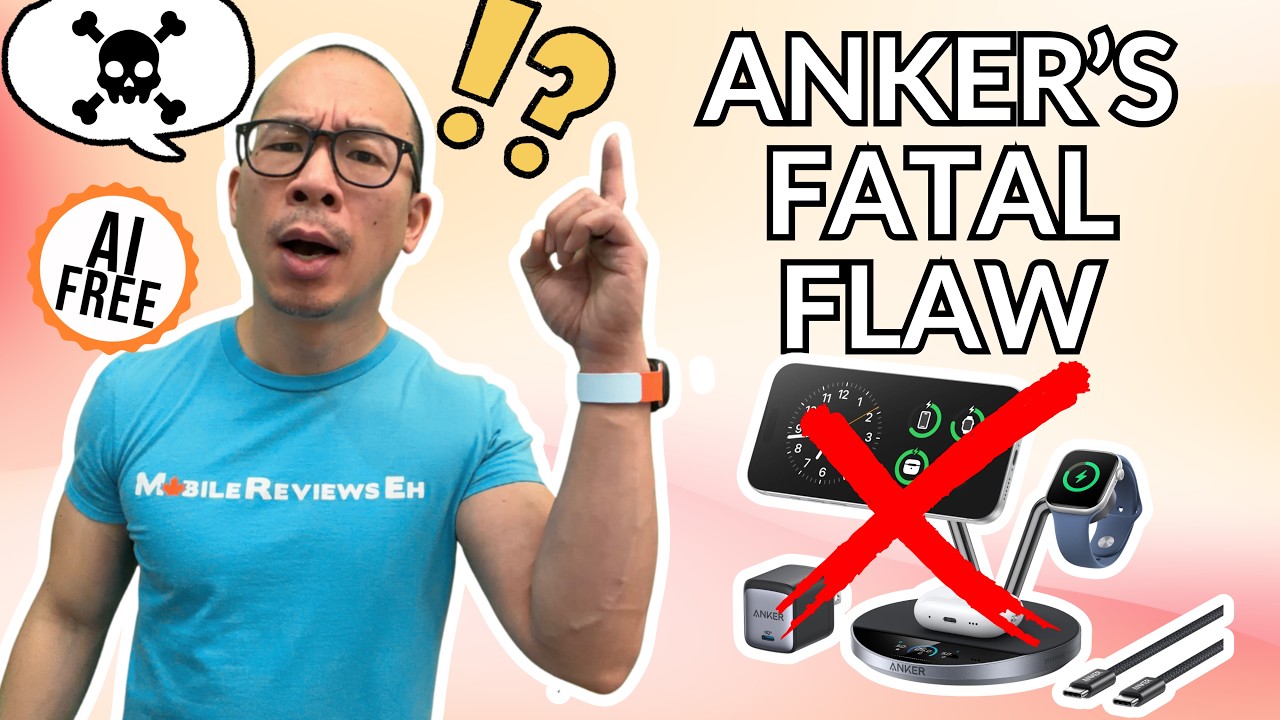
Where the handshake does work, the gains are real but modest, and they are not evenly distributed. MobileReviewsEh spent close to a thousand dollars of his own money on Qi2 25W multi-device chargers and logged more than 200 hours of charging data, testing each dock solo and fully loaded with a phone, earbuds and a watch, on both a Pixel and an iPhone. He is blunt about why: "I'm a reviewer, not an influencer."
His figures cluster tightly. Thirty minutes on the winning ESR travel charger returned 58% fully loaded and 60% solo. Belkin's Ultra Charge Pro managed 56% and 57%. Watches landed on about 51% across the board. Anker's Prime 3-in-1 dock hit 59% on an iPhone — and here the pattern breaks. Normalised against the Pixel, the same dock delivered roughly 30%. It is Qi2 capable, he concluded, but tuned for iPhones, and not the product to buy for a mixed-device household. Belkin, by contrast, charged Pixel and iPhone at identical rates, with identical heat and efficiency.
Fans matter too, and not as marketing garnish. The Belkin's toggle — which he initially mistook for a power button — moved its 30-minute result from 51% to 56%. On the ESR unit, twin fans bought speed at the cost of efficiency and a hotter-than-average surface.
The heat tax nobody puts on the box
Heat is the reason all these numbers stay stubbornly below the label. AB Two Phones, testing slim Qi2.2 25W power banks, measured a Baseus Pico Go AM52 drawing 30W to refill itself while pushing 15W into the phone. After 45 minutes, the Baseus sat at 101°F with the phone at 100°F; a new Anker 25W pack matched it almost exactly. The only pack that both charged fastest and ran coolest in his testing was the one with active cooling built in — and its fan cannot be switched off.
The physics behind that tax got a caustic reading this week from the channel Zeus, whose video argues wireless charging was "engineered as a master class in selling you a worse technology at a massive markup." Citing iFixit's measurements, the video notes a wired charge barely pushes a battery past 30°C, an aligned MagSafe connection climbs toward 40°C, and a misaligned phone on a cheap pad stays above 40°C for most of the cycle. On power draw, it puts aligned MagSafe at 36% more energy than a cable for the same charge, with misalignment sending that past 100%. Its two concessions are worth keeping: skipping the cable spares the charging port, which is among the most common reasons a phone ends up in a repair shop, and it sidesteps a wet or lint-filled port.
How to read the spec sheet now
None of these testers reached for the same conclusion, but their data converges. Treat 25W as the best case in a chain where every link can quietly veto it. If you own a Galaxy S26 Ultra, check whether your specific case is on the list that negotiates the full handshake before assuming the pad you bought is faulty. If your household mixes Android and iPhone, a charger's headline figure tells you nothing about the phone it was not tuned for — Belkin's parity and Anker's iPhone bias came off the same test bench. And if you want the phone full in a hurry, the fastest option on every bench here remained the cable: the S26 Ultra that crawled at 5W on a pad drew about 11 amps and reached roughly 58W plugged in, filling in about 49 minutes.
Wireless charging is a convenience feature with a wattage number attached for marketing reasons. The convenience is genuine. The number is negotiable.