Huawei Watch GT 7 nails heart rate, but sleep remains its blind spot
Independent tests agree Huawei's new watch is unusually accurate during exercise and lasts for days. Its sleep staging and smart features remain the compromise.
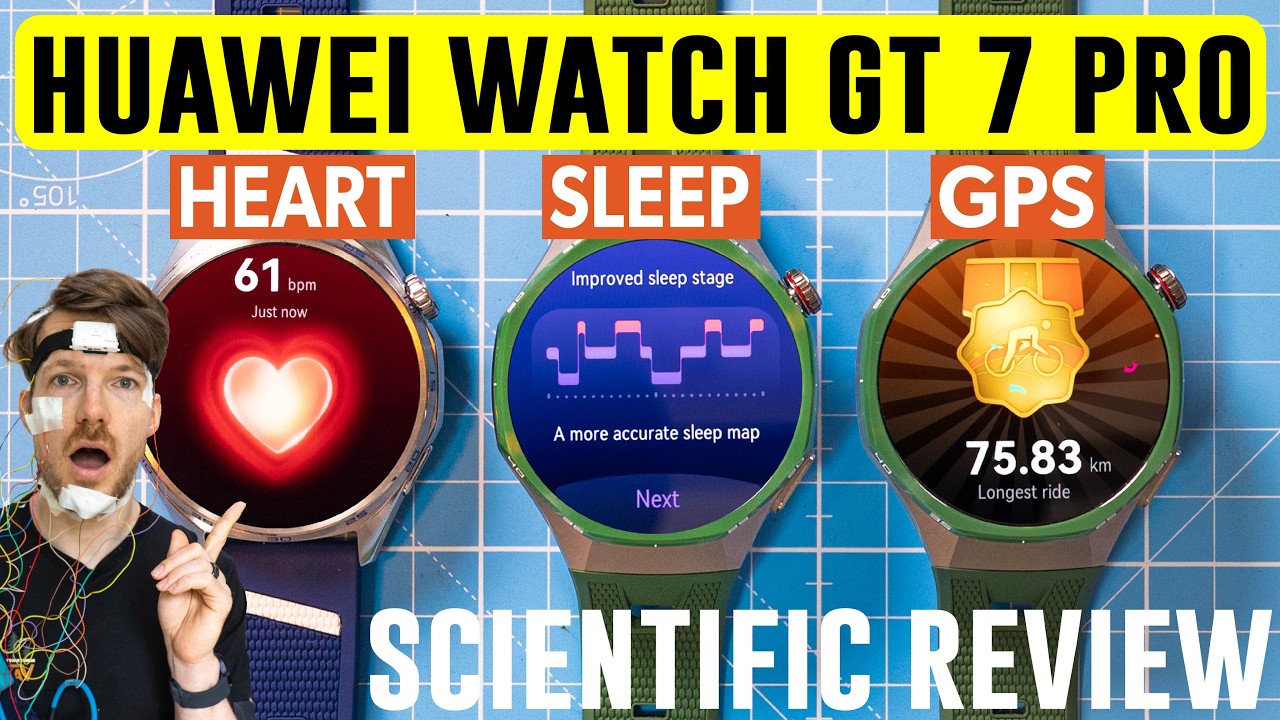
Huawei has built a sports watch that is very good at watching you move and noticeably less convincing once you fall asleep. That split matters more than the headline 3,000-nit display or the long list of outdoor modes on the new Watch GT 7 family.
The Watch GT 7 and GT 7 Pro went on sale in parts of Europe on 2 September. The standard watch starts at €299, while the 46mm Pro costs €429. After laboratory work, exercise tests and on-bike use, independent reviews landed in the same place: heart-rate tracking is a strength, battery anxiety is unlikely, and the Pro premium buys materials and specialist tools rather than better everyday data.
Two labs found the pulse sensor hard to fault
The strongest evidence comes from tests against chest straps. Computer Bild measured the standard GT 7 against a reference strap and recorded an overall heart-rate deviation of just 1.2 percent, including exercise with forceful arm movement.
Rob ter Horst of The Quantified Scientist tested the GT 7 Pro against a Polar H10 ECG strap. Correlation reached 0.99 for indoor cycling and for running, 0.98 for outdoor cycling and 0.93 for weightlifting. Lifting still missed some peaks, a familiar weakness for wrist-based optical sensors, but the watch finished better than roughly three quarters of the devices in his comparison set. He put the spread at about 72 percent for indoor cycling, close to 80 percent for outdoor cycling and running, and close to 75 percent for lifting.
There is an awkward footnote for owners of last year's model. Ter Horst found the GT 7 Pro broadly level with the GT 6 family rather than clearly ahead. The new watch is excellent at this job, but excellence carried forward is a thin upgrade reason.
Sleep stages tell a messier story
Huawei's TruSleep 5.0 algorithm is the new sleep-stage scorer. Ter Horst's comparison with a ZMax EEG headband suggests the average result improved: his overall sleep score moved from roughly 50 to 51 on the GT 6 family to 64 on the GT 7 Pro. Deep-sleep agreement reached about 91 percent and light sleep 62 percent. REM agreement fell to 37 percent on his nights, with much of the reference device's REM classified as light sleep instead.
Computer Bild found a related problem in a separate test of the standard model. The watch failed to recognise waking periods accurately and misplaced the final wake time. These are small-sample findings, not universal clinical results, but their agreement is useful. Buyers should treat the nightly stage chart as a wellness estimate, especially if REM or time awake is the number they care about.
The broader health package includes heart rate, blood oxygen, stress, skin temperature and heart-rate variability. ECG is reserved for the Pro, and availability of features such as arrhythmia analysis can vary by market. None of those wellness readings replaces a diagnosis.
The cycling tools are more useful than the marketing
The most practical new software is Huawei's Climb Planning. Import a route through Huawei Health and the watch previews the elevation line, then breaks out climbs with distance, elevation gain and average gradient. On the road it flags the start of a climb, tracks remaining distance and can warn about sharp turns.
Golem titled its Pro review as the watch almost becoming a bike computer. Notebookcheck actually rode with the new cycling mode, imported routes from Huawei Health, and found remaining distance, direction of travel, climb analysis and sharp-turn warnings clear enough to read at a glance. That still overstates the case if you need a large map, many data fields or dependable all-day navigation, but it is a meaningful addition for recreational riders who do not want another screen on the handlebars.
The standard and Pro share dual-band satellite positioning and the same 1.47-inch, 466-by-466 display in their 46mm forms. Computer Bild found the panel easy to read in every light it tried, including the always-on face, with some reflections on the glass. Ter Horst's first running route also looked accurate, although later GPS tests were compromised because assisted-GPS data had not been refreshed after he left the watch unsynced, so he treated those later traces as unreliable.
Standard or Pro is mostly a materials decision
The 46mm standard model uses a stainless-steel front and a fibre-reinforced composite back, weighs 51.3g without a strap and carries 5ATM and IP69 ratings. The Pro steps up to a titanium-alloy case, nano-ceramic bezel and back, and sapphire glass, then adds ECG, a depth sensor, free-diving support to 40 metres and expanded golf and map features.
That tougher glass has a real purpose. Computer Bild's scratch testing left marks on the standard case at level three of nine and on its display at level five, worse than the predecessor. The watch survived the publication's water-column test, but its polished appearance deserves care.
Huawei rates the 46mm standard watch for 12 days of typical use, seven days with the always-on display and 51 hours of trail running. Computer Bild's smaller 41mm unit exceeded its five-day always-on claim and ran for eight days in the publication's use. Those results help explain the GT line's appeal, but the software remains a trade: there is no Wi-Fi or cellular connection, the app selection is smaller than Wear OS or watchOS, and Android users may need to install Huawei Health outside Google Play.
For most buyers, the €299 46mm GT 7 is the sensible version. It keeps the bright screen, positioning hardware, sports tools and long endurance. Spend the extra €130 on the Pro if sapphire, diving, ECG or golf genuinely belongs in your week. Existing GT 6 owners already have much of the good data, so their cheapest upgrade is to keep wearing it.