Fitbit Air is a $99 sleep tracker that keeps losing the bike ride
Testers wearing Google's screenless band for months praise overnight sleep and heart data. Auto-detect still drops bike rides, CrossFit and stairs, and some heart-rate sessions jump 20 to 90 beats.
Lauren Allain spent three months in a Fitbit Air, then told Google's AI coach she had been picking blueberries. The coach logged one cup of blueberries eaten. Mashable published that long-wear note this week, and it is a neat summary of a $99 screenless band: the hardware vanishes on a wrist, the overnight numbers often hold, and the software still files a snack when you were trying to log light work in the yard.
Friends at dinner thought Allain was wearing a bracelet. Google's US store lists the Air from $99.99, 12 grams with the band, water-resistant to 50 metres, with a claimed seven-day cell and a 90-minute full charge. Allain got a bit over eight days and a full charge in 67 minutes. On YouTube, after two weeks, Mike O'Brien said, "Of all the fitness trackers I've ever worn, this is very likely the most comfortable one." Alex Lee at The Independent wore one against a Whoop 5.0 for two months and kept forgetting it was there.
An old optical sensor, overnight
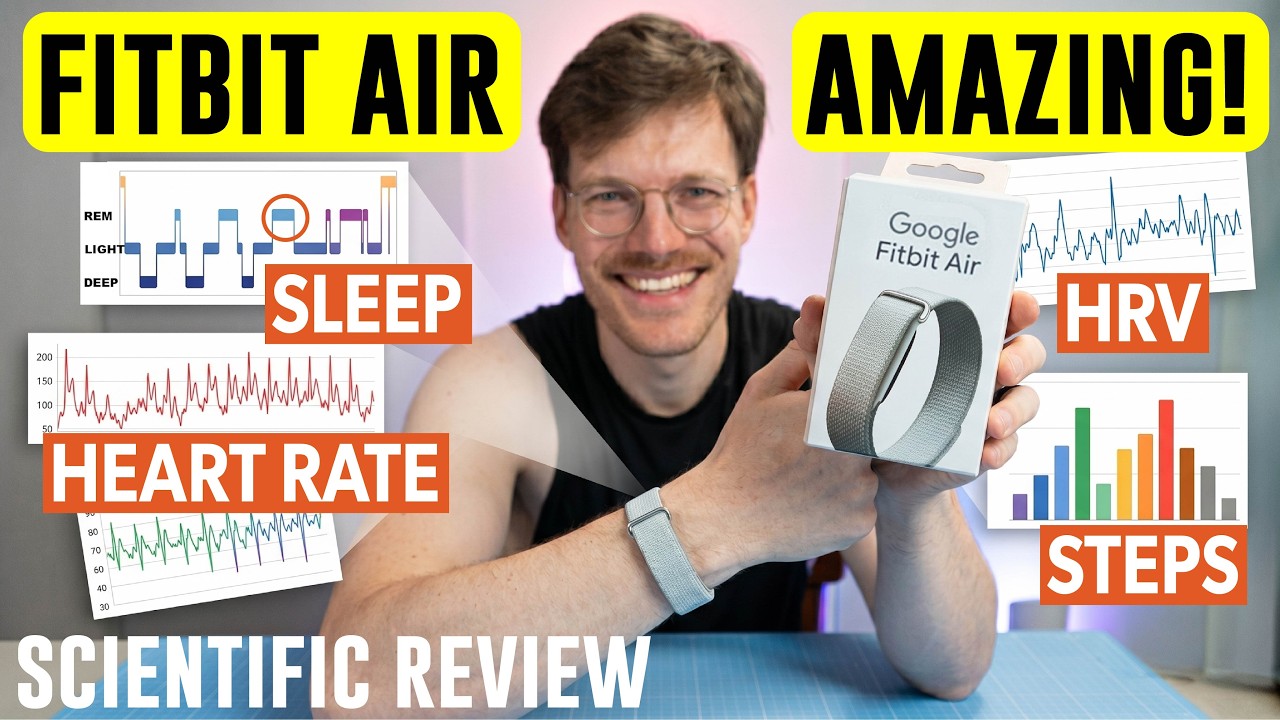
The pebble uses the same heart-rate array as older Fitbit Charge and Inspire models. Rob ter Horst, the postdoctoral scientist behind The Quantified Scientist, opened his test with that lineage, then added, "I'm impressed by what Google was able to do with this old sensor." Against a Polar H10 chest strap, his indoor cycling sessions hit a 0.99 correlation. Averaged across three cardio tests, he scored the Air 97 and called the result great for the price.
Night-time heart rate, compared with an ECG strap, overlapped closely. Heart-rate variability patterns tracked even when the absolute RMSSD values did not. Sleep stages were the larger surprise. Against a Zmax EEG headband, ter Horst recorded about 87 percent agreement on deep sleep, 80 percent on light and 72 percent on REM. He put that among the top five brands in his testing, with Apple Watch, Whoop, Oura and the Eight Sleep Pod, and noted the Air is the cheapest of that group. Sleep stages do not need Google Health Premium.
Lee, battling severe jet lag in Japan, went to bed at 3:12am and got two hours 21 minutes. His sleep score fell to 49 and readiness to 25 the next day, with the Air tying the crash to the travel rather than to him. O'Brien, ill for several days, watched readiness sit on 15 while HRV and resting heart rate tracked the slow improvement he felt. Allain barely noticed the band in bed and called the sleep metrics her new favourite. Naps were the leak: she estimated the Air caught about half of them, and Google's 20-minute threshold did not explain the misses.
The ride that never happened
Google's spec sheet stores seven days of detailed motion and one day of workout data. There is no GPS in the pebble. Distance for a run or ride depends on a phone coming along, and testers do not even agree whether that hand-off works. Andrew Williams at Expert Reviews wrote that connected GPS is not supported, and after weeks of stride calibration his run distances still sat about 1.1 times short of a Garmin Forerunner 970. DC Rainmaker's Ray Maker says the phone can supply a map, then watched those maps fail on manual sessions, leaving heart rate and a ghost activity behind.
Auto-detect is narrower still. Ter Horst notes an activity is not logged automatically until 10 or 15 minutes in, depending on type. Lee's Whoop caught CrossFit, Olympic lifting and Hyrox-style work; the Air often needed a typed-in session. Allain's rides were captured about 75 percent of the time. A grocery loop with two 12-minute bike legs registered as a walk. Stairs climbed stayed at zero for weeks, even as weekly reports kept asking.
Sport heart rate is where the skinny optical window shows. Maker's charts mixed outdoor rides he called pretty darn good with sessions 20 to 40 beats high, which then inflated Cardio Load, Fitbit's 24-hour strain score. Williams recorded a 150 bpm average against 128 on the Garmin across an 80-minute workout. Ter Horst's outlier hike jumped to about 170 bpm while he was closer to 80. He treated that as a one-off, possibly a poor fit. It is still the number the coach will preach from.
Pay for chatter, not for the numbers
Google Health Premium is $9.99 a month or $99 a year after a three-month trial. Core metrics stay free: steps, Cardio Load, readiness, sleep stages, heart rate, HRV, breathing rate, SpO2. Maker ran his wife on a free account and himself on Premium. The numbers matched. The talk did not. After he sarcastically asked whether nacho cheese, chips and rosé counted as recovery food, the coach asked about queso and wine every night. "And Google never forgets," he said in the review. Every night since, the coach has brought it back up.
Victoria Song at The Verge spent hours feeding medical context into the same AI coach, then watched it revert to a 10,000-step goal she could no longer hit. Allain still likes the weekly plans enough to keep Premium. Lee calls Google Health one of the smartest health apps he has used, and still thinks dedicated athletes and CrossFitters belong on Whoop. DesFit, reviewing the same band, put the appeal plainly: $99 is an attractive price for round-the-clock health tracking, and the core functions working without a subscription is, on that reading, a large part of why the Air is getting this much attention.
Buy the Air if you want overnight health without a watch face and without paying Whoop's membership just to see last night. Keep a GPS watch on the other wrist if the session itself is the point. The blueberries can stay in the yard.