MediaTek's 2nm Dimensity 9600 Pro is the real story. The 9600M beside it is a 9500 in a new jacket
The Dimensity 9600 Pro claims a 61% cut in multi-core power on TSMC's 2nm node, and an early engineering sample backs the GPU numbers. The 9600M announced alongside it is 3nm silicon with last year's GPU and NPU.
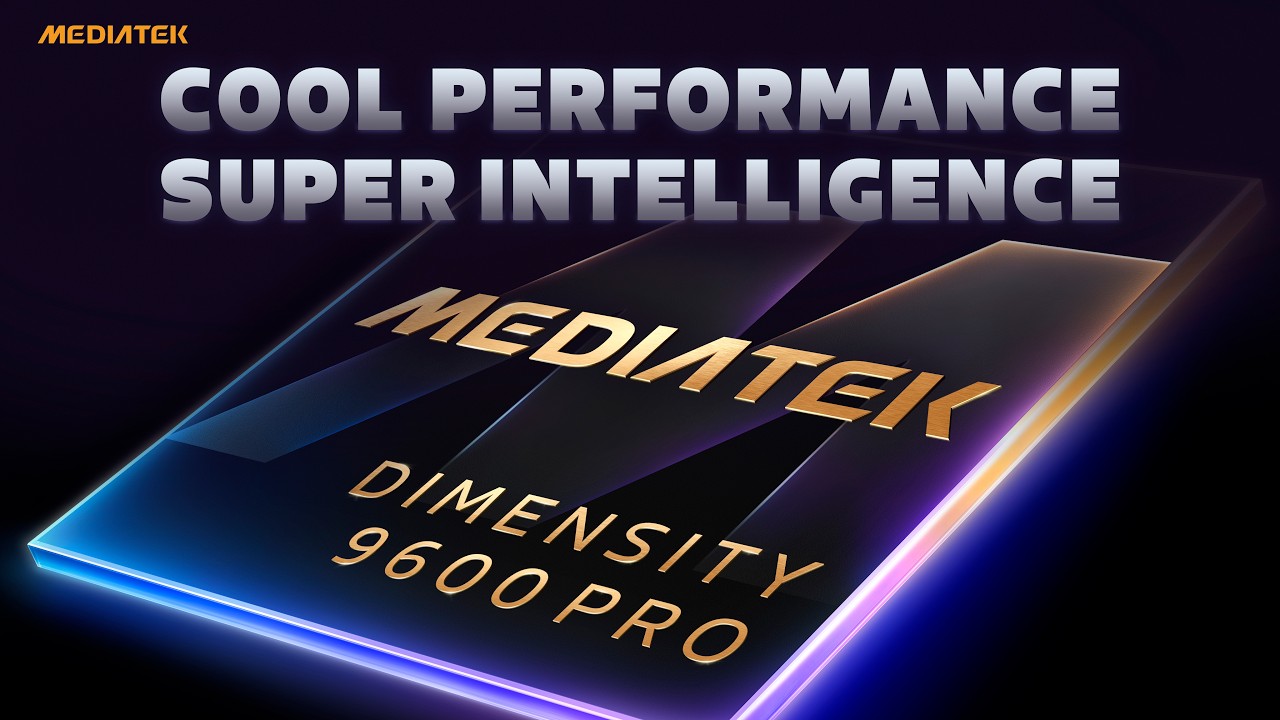
MediaTek got to 2nm first. Not first to ship — the first phones with the Dimensity 9600 Pro are still a few weeks out — but first to stand up and announce a flagship mobile SoC built on TSMC's 2nm class node, which in a year of chip-supply brinkmanship counts for something. The announcement landed in Hsinchu on 15 September, and the spec sheet is more interesting than the headline number.
Eight cores, none of them small
The CPU is a 2+3+3 arrangement MediaTek calls "All Big Core": two Arm C2-Ultra cores at up to 4.55GHz, three C2-Pro cores at 4.35GHz, and three more C2-Pro cores at 3.1GHz. Compared with last year's Dimensity 9500, that swaps a fourth small core for a second prime core — a bet that burst responsiveness matters more than a wide low-power floor.
MediaTek's own claims are modest on raw speed and aggressive on power: up to 17% higher single-core and 15% higher multi-core performance, against a 61% reduction in multi-core power consumption. GSMArena's spec breakdown puts efficiency gains at 37% single-threaded and 61% multi-threaded, which is the figure worth staring at. A 15% performance bump is a normal year. Cutting multi-core power by roughly two-thirds is a node story, not an architecture story.
Trakin Tech English's presenter, Ashad, ran an engineering sample before launch and measured 4,204 single-core and 12,206 multi-core in Geekbench 6 — an 18% and 15% improvement over the 9500 on his bench, close enough to MediaTek's lab figures to be credible. They were careful about what they did not publish, skipping AnTuTu on the grounds that memory and UX tuning on a prototype does not represent a shipping phone. More reviewers should be that fussy.
The parts nobody puts on a slide
Cache went up to 34.5MB across L2, L3 and system level. The chip is the first Dimensity to support LPDDR6, alongside continued LPDDR5X compatibility, and it moves to UFS 5.0 storage. LPDDR6 runs about 33% faster than the outgoing memory and costs more, which is why the dual support matters: phone makers can choose which side of the RAM-price crisis to stand on.
The GPU is a 12-core Arm Mali-G2 Ultra NX, claimed at 27% higher peak performance, 24% lower power at peak, and 18% faster ray tracing. Their Steel Nomad Light run matched the 27% figure exactly; Solar Bay Extreme came in at 19%. Their most revealing test was Hitman: Absolution, a Feral Interactive PC port, where the 9600 Pro averaged 119.13fps against 80.29fps on the 9500 — a 48% gap that says more about sustained thermal headroom than about peak silicon.
On AI, the NPU 1090 doubles INT4 throughput over the 990, adds a hardware compression engine for the KV cache, and claims 51% faster prompt prefill with 55% better token generation per watt. MediaTek says it handles on-device models up to 30 billion parameters. A second, always-on NPU cuts standby AI power by a claimed 40%.
One regression, one honest downgrade
The Imagiq 1290 ISP can now hand frames directly to the NPU rather than shuttling them through the CPU, and it brings 4K240 native slow-motion capture, 4K120 log recording and 17EV of claimed dynamic range. The video decoder adds VVC (H.266) support, which almost nothing currently uses and which will matter in three years.
The quiet regression: maximum supported sensor resolution drops from 320MP on the 9500 to 200MP here. Nobody ships a 320MP phone sensor, so this is a paper cut rather than a wound, but it is the rare spec that went backwards.
About that second chip
MediaTek also announced the Dimensity 9600M, framed in its press release as "bringing flagship experiences to more users". Read the specification table GSMArena published two days later and the framing gets thinner. The 9600M is built on TSMC's 3nm N3P process with a 1+3+4 core layout topping out at 4.21GHz, an Arm Mali-G1 Ultra MC12 GPU, the older NPU 990, LPDDR5X memory and UFS 4.1 storage.
That is, component for component, a Dimensity 9500 wearing a 9600-series badge. What it inherits from the Pro is software — the Agentic AI Engine and the Dimensity Scheduling Engine. Buyers scanning a spec sheet for "9600" will not read the M as three-nanometre last-generation silicon, and that is presumably the point.
Where it lands
Oppo's Find X10 Pro Max is confirmed as a launch device with global availability, and Vivo's X500 Pro is on the list too, per The Verge's Dominic Preston. MediaTek says the first phones with both new chips arrive this quarter. Qualcomm's Snapdragon Summit follows on 22 September, and the Snapdragon 8 Elite Gen 6 has its own 2nm story to tell — one currently tangled in a pricing standoff with Samsung Foundry.
The Dimensity 9600 Pro's claims all came from MediaTek's own labs, and the one independent benchmark run so far used a prototype. Judge it when Oppo ships. But a 61% multi-core power reduction, if it survives contact with a retail phone and a real thermal budget, changes what a flagship Android battery has to be.